11 Best Online Workout Programs, According To Our Fitness-Obsessed Editors

It’s no secret that movement plays a major role in long-term health. Regular exercise has been linked to benefits such as improved cardiovascular health1, better sleep2, and even reduced depressive symptoms3. Luckily, online workout programs have come a long way in the past few years, making it easier than ever to stay active and reap those benefits without relying on a rigid schedule (or, in many cases, even gym access).
What once were grainy, follow-along videos are now robust platforms with expert instructors, structured, science-backed programs, and enough variety to support everything from strength training to dance cardio to low-impact movement.
As someone who’s tested countless fitness apps over the years, I’ve learned that choosing the best online workout program really comes down to how you like to train, what keeps you consistent, and what you’ll actually look forward to doing.
Some people want a fully guided plan, others want variety, and others just want something quick and simple that fits into a busy schedule without needing to think too hard about it.
Below, I’ve rounded up the best online workout programs worth your time right now, broken down by category so you can find what fits your goals, lifestyle, and motivation style.
- Best for all-in-one training platform: Fitness Online**
- Best for personal training: Future Pro
- Best for Pilates & strength training hybrid: FORM
- Best for low-impact toning: B The Method
- Best for sculpting: Kristin McGee
- Best variety: Obé
- Best for group fitness: Peloton
- Best for strength training: Les Mills+
- Best for yoga: Alo Wellness Club
- Best for prenatal & postpartum: The Sculpt Society
- Best for running: Strava + Runna
How we picked the best online workout programs
When selecting our final list of the best online workout programs, I evaluated each platform based on a few key factors:
- Quality of instruction
- Variety and depth of programming
- Ease of use and overall experience
- Who it’s best suited for (and who it’s not)
- Whether I’d realistically recommend it to a friend
These are programs I’ve either personally tested, spent meaningful time exploring, or consistently seen deliver results for a wide range of people.

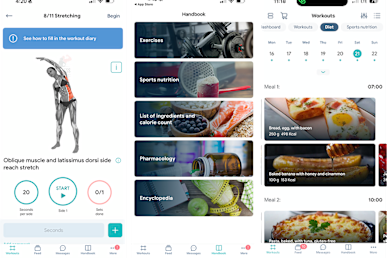 Image by Carleigh Ferrante / mbg creative
- Subscription cost:
- Monthly and annual options available
- Free trial period:
- Free version; trial available for paid features (14 days)
- Workouts offered:
- Full body workouts with goal-specific plans and large exercise library
- Class length:
- 45 minutes and longer
Pros & Cons
Pros & Cons
Pros
Structured workout plans designed around specific goals
3D exercise demonstrations make form easy to follow
Built-in tracking for sets, reps, and progress
Nutrition and coaching tools available
Standalone apple watch integration
Cons
Less of a “live class” vibe than some streaming platforms
If you like having a clear plan to follow and a simple way to track your progress over time, Fitness Online is a great choice. This user-friendly app offers a highly structured approach to training and nutrition, no matter your goals.
In my month of testing Fitness Online, I was impressed by the wide range of programs and the customization options. Once you select your specific goal (e.g. general muscle building, weight loss, or to focus on specific muscle groups like abs, back, or glutes) and choose the right training plan for your goals, you can use the app’s diary feature to log my sets, reps, and weights directly in the app (or via the standalone Apple Watch mode).
This data allows the app to provide advanced workout analytics with data-driven feedback based on active muscle groups, distribution by exercise type, workout duration, rest time, total weight lifted, average heart rate, calories burned, and more. This in-depth data makes it easy to track your progress over time and to understand how far you’ve come.
As someone who only recently started training in the gym over the past couple of years, far and away my favorite feature of Fitness Online is the app’s 3D animated exercise demonstrations. I’ve tested other apps that simply show a picture or tell you the name of the exercise, and I’m always concerned about whether I’m using the correct form—so these animations are super helpful! I also like that the animations show exactly what part of the body is targeted, with 'Right vs. Wrong' visual comparisons that help correct form instantly (a huge win for beginners!).
And while I’d be tempted to solely focus on the workout features, this all-in-one platform goes beyond workouts. Nutrition is a huge part of what Fitness Online offers. Along with calorie and meal tracking, the app offers an extensive recipe database with 10,000+ recipes crafted by certified nutritionists. Recipes are localized to regional products—and you can use the macro-adaptive tracking to tailor meals to your preferences and dietary needs.
Another perk: There’s an encyclopedia feature to find answers to your fitness questions, as well as a community corner to connect with other users and share motivation and progress.
Our verdict:
Fitness Online stands out as more of an all-in-one platform, rather than just a library of workout plans. It’s a standout pick for anyone who wants a structured workout plan with built-in tracking, nutrition tools, and coaching resources.
- Subscription cost:
- $199 per month after a $50 introductory first month
- Free trial period:
- No traditional free trial; satisfaction guarantee with full refund if you cancel within 30 days. A separate free Future beta exists, but may require joining a waitlist.
- Workouts offered:
- Personalized strength training, mobility, conditioning, sport-specific training, prenatal/postnatal–safe training (coach-dependent)
- Class length:
- Varies by plan; typically 30 to 60 minutes per session
Pros & Cons
Pros & Cons
Pros
One-on-one coaching with a certified personal trainer
Fully personalized workouts that adapt to your goals and schedule
Real-time adjustments and in-workout coaching
Cons
Significantly more expensive than others on our list, but still less than IRL personal training sessions
Free Future beta does not include one-on-one personal coaching
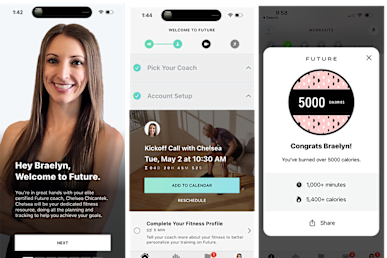
Future Pro is designed to replicate the experience of working with a personal trainer in real life, but delivered entirely through an app. When you join, you’re paired with a certified coach from a roster of over 130 trainers, which you can filter by things like expertise (strength, weight loss, mobility, pregnancy, sport-specific training), coaching style, gender, and languages spoken.
Your coach then builds a personalized workout plan based on your goals, schedule, available equipment, and current fitness level. Workouts are delivered directly in the app with in-workout coaching cues, and plans can be adjusted in real time for things like injuries, travel, or changing energy levels.
If you wear a fitness tracker, your coach can also use data like heart rate, recovery, and strain to inform programming over time.
Our verdict:
Future Pro offers one of the most personalized digital training experiences available. It’s a strong fit for anyone who wants true accountability and expert guidance, rather than a self-guided workout library.
Editor’s tip:
- Subscription cost:
- $30 monthly or $150 annually
- Workouts offered:
- Strength training, Pilates, sculpt, Pilates x strength, gym workouts, prenatal/postnatal
- Class length:
- 10 to 45+ minutes
- Equipment used:
- Mat; dumbbells, ankle weights, resistance bands, some gym equipment depending on the workout
Pros & Cons
Pros & Cons
Pros
Combines strength and Pilates into weekly, guided plans
Minimal equipment required for most workouts
Lots of options for different goals and durations
Cons
Not the best choice if you want pure HIIT or high-intensity training
Requires subscription for full access after trial
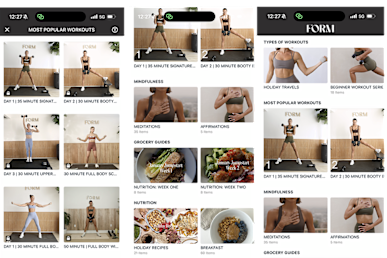
FORM is a guided fitness platform that blends Pilates, strength training, gym workouts, sculpt, and body-weight workouts. Members can pick and choose their workouts daily, or they can follow curated plans each week. The app also regularly drops tailored specialty programs such as a Back to Gym program, Express Series, Advanced Mat Pilates, 2-Week Bridal Program, and a Prenatal and Postpartum program.
I love how knowledgeable and engaging the instructors are, and that they always give cues for modifications throughout every workout. It’s easy to make the workout easier or harder, simply by grabbing heavier weights or opting to do bodyweight as needed. The platform also has a mindfulness focus, with a library of meditations and affirmations, as well as nutrition support with grocery guides and recipes.
What stands out most about FORM is the instructors’ ability to expertly blend various forms of workouts into one platform that still feels uniform, intentional, and aligned. I’ve been using the FORM app for over two years now, and I’ve become so much more confident in my strength training and gym training abilities. Plus, I’ve seen great results with muscle growth and toning.
Our verdict:
FORM’s strength and Pilates hybrid makes it appealing to people who want toning, functional strength, and mindful movement in one place. The workouts are fun (huge perk!) and easy to modify to your experience level, and the weekly structure promotes consistency.
Editor’s tip:

- Subscription cost:
- $18 monthly or $160 annually
- Free trial period:
- 7-day free trial
- Workouts offered:
- Low-impact Pilates-based toning, sculpt, core, prenatal/postnatal, restorative movement, livestream classes
- Class length:
- 10 to 60 minutes
Pros & Cons
Pros & Cons
Pros
New workouts weekly
Focuses on mobility, strength, pelvic floor health, and flexibility
Includes tutorials and tips for improving form for all body types
Cons
Less variety for high-intensity training
B The Method is a Pilates-based workout program designed by classically trained instructor, Lia Bartha. Lia’s method emphasizes low-impact, full-body movement, and covers Pilates fundamentals, deep core activation, pelvic floor strength, weighted series, restorative movement, prenatal and postnatal, and weekly livestreams with community Q&A. There’s a library of hundreds of on-demand classes ranging from 10 to 60 minutes,
Lia has a highly informative teaching style, making the platform great for all levels. I personally did not have much experience with Pilates prior to joining B The Method five years ago, and I was immediately hooked. I’ve seen a huge improvement in my posture and flexibility and gained a better understanding of my body—yet the workouts continue to challenge me, in the best way.
While there are some advanced strength classes with heavy weight options, the classes are primarily done with minimal or no equipment. I always come to this platform when I want something low-impact that still feels like a deep workout. There’s also a full library of specialized programs such as the Sexual Health Program, Gut Reset Program, and the Stress Less, Sleep More program.
Our verdict:
If your goal is sustained toning, improved strength without high impact, and movement that feels supportive, B The Method should be on your list. Lia delivers a steady, accessible approach, grounded in classical Pilates principles.
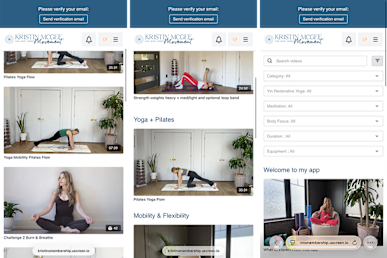 Image by Carleigh Ferrante / mbg creative
- Subscription cost:
- $29 monthly or $288 annually
- Free trial period:
- 7-day free trial
- Workouts offered:
- Pilates, yoga, sculpt, core, strength-focused flow
- Class length:
- 10 to 60 minutes
Pros & Cons
Pros & Cons
Pros
Strong focus on core strength, alignment, and sculpting
Calm, clear instruction that’s easy to follow
Great option for low-impact but effective workouts
Cons
Smaller content library than larger platforms
As soon as I tested Kristin McGee’s workouts I understood why she has a cult following. While her classes are more barebones than some others on this list (they’re not heavily produced, and they’re just filmed in her home studio on a mat), they’re so engaging. The platform has a library of Yoga, Pilates, Strength, Flexibility, and mobility.
Kristin McGee is ideal if your goal is feeling more connected to your body through intentional movement. Most classes focus on controlled, precise movement, with an emphasis on alignment, breath, and deep core engagement. I personally enjoyed the classes that blend Pilates and Yoga together..
I like how easy it is to sort through the library of content based on what type of movement I’m in the mood for, what equipment I have access to, what part of my body I want to focus on, and how much time I have. While testing various online workout programs I found myself returning to Kristen McGee on days when I wanted something more mellow and grounding.
Our verdict:
Kristin McGee’s platform is a strong option for anyone who wants yoga, Pilates, or strength workouts rooted in proper form and mindful movement.
Editor’s tip:
- Subscription cost:
- $25 monthly or $170 annually
- Free trial period:
- 7-day free trial
- Workouts offered:
- Dance cardio, HIIT, strength, sculpt, Pilates, yoga, mobility, stretching, and more (20+ class types)
- Class length:
- 10 to 60 minutes
Pros & Cons
Pros & Cons
Pros
Huge variety of workout styles in one platform
Live and on-demand classes available
Energetic instructors and upbeat tone
Cons
Can feel chaotic if you prefer a set plan
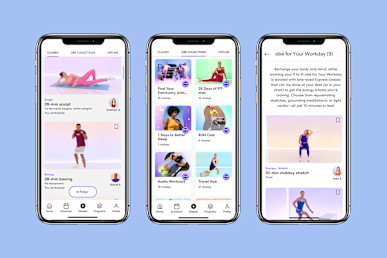
If you tend to lose interest when workouts feel repetitive, Obé is for you. One of the most varied platforms available, it offers more than 20 types of workouts including dance cardio, HIIT, sculpt, Pilates, strength, ride, mobility, and more.
Classes are led by an extensive roster of instructors, and span both live and on-demand formats, which helps keep things feeling fresh. With just one membership, you can jump into a high-energy cardio class one day and a slower sculpt or stretch session the next without switching platforms.
Obé is less about following a strict program and more about making movement fun and accessible, which can be a big win if motivation is your biggest hurdle.
Our verdict:
Obé is an excellent option for women who want a variety of workouts and a mix of live and on-demand classes. Just keep in mind: You'll typically get the best results with equipment.
Editor’s tip:
 Image by Carleigh Ferrante / mbg creative
- Subscription cost:
- $13 monthly or $129 annually
- Free trial period:
- 30-day free trial
- Workouts offered:
- Cycling, running, strength, bootcamp, yoga, Pilates, mobility, stretching, and more.
- Class length:
- 5 to 90 minutes
Pros & Cons
Pros & Cons
Pros
High-quality instructors and production value
Wide range of group-style classes
Strong community and motivation features
Cons
Equipment-specific content may feel limiting
Subscription cost can add up over time
Peloton is best known for its cycling classes, but the platform has options well beyond the bike. It offers a full slate of workouts including strength training, running, bootcamp, yoga, Pilates, and mobility.
What makes Peloton stand out is the studio-class feel. The instructors are highly polished, the music is front and center, and the leaderboard and community features add an extra layer of motivation for people who thrive on shared energy.
While some classes require Peloton equipment, many strength, yoga, and mobility workouts can be done with minimal gear, making the app useful even without owning a bike or treadmill.
Our verdict:
Peloton delivers a true group fitness experience at home. It’s a great fit for anyone who’s motivated by instructor energy, music, and a strong sense of community.
Editor’s tip:
 Image by mbg Creative / LES MILLS
- Subscription cost:
- $15 monthly or $180 annually
- Free trial period:
- 14-day free trial
- Workouts offered:
- Strength training, HIIT, cardio, mobility, flexibility
- Class length:
- 20 to 60 minutes
Pros & Cons
Pros & Cons
Pros
Well-structured, progressive strength programming
Clear instruction and form cues
The app integrates music seamlessly into workouts
Cons
Certain Les Mills+ programs require specific fitness equipment
Less flexibility for customization
Les Mills+ is built around structured, science-backed programming designed to build strength and endurance over time. Many of its workouts follow repeatable formats, which helps you focus on progression rather than constantly learning new movements. If you’re into routines that keep you consistent, this is the program for you.
The platform is heavily rooted in group fitness, with clear instruction, consistent class structures, and a strong emphasis on proper form. Strength classes are efficient and challenging (be warned: You will sweat a lot) without being overly complicated.
There are thousands of classes to choose from, with a variety of methods available including strength training, cycling, dance, aerobics, HIIT, yoga, and martial arts. Each class is led by world-class instructors with options for beginner, intermediate, and advanced athletes—and the online community has more than 150,000 members, all of which are given access to a Facebook group to connect and share progress.
Our verdict:
With a massive on-demand library, a ton of exercise types, and a built-in community to connect with, Les Mills+ is an excellent option for both beginners and advanced athletes. Depending on which class type you choose, you may want to invest in a set of adjustable dumbbells to really amp up your results.
Editor’s tip:

- Subscription cost:
- Free
- Free trial period:
- N/A
- Workouts offered:
- Yoga (various styles), Pilates, barre, sculpt, meditation, breathwork, and more
- Class length:
- 5 to 90+ minutes
Pros & Cons
Pros & Cons
Pros
Lots of variety (including yoga, fitness, and mindfulness practices)
Entirely free
High production quality
Cons
Some instructors are not as detailed with explaining poses
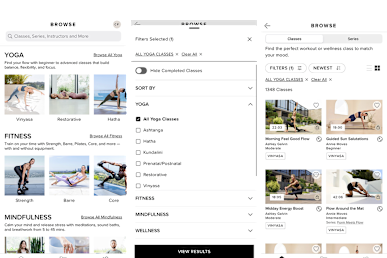
Alo Wellness Club (formerly Alo Moves) began as a yoga platform, but now is actually one of the most comprehensive options on our list. Oh, and it’s entirely free.
When it comes to yoga though, Alo Wellness Club offers classes for a range of styles, skill levels, and goals. From slow, restorative flows to more challenging strength-based practices, the depth of content makes it easy to build a consistent yoga routine.
Beyond yoga, Alo Wellness Club also includes a wide variety of fitness classes, including Pilates, barre, sculpt, HIIT, strength, dance, prenatal/postnatal, and more. The platform also now offers mindfulness classes such as reiki, sound baths, breathwork, and meditation, along with focused wellness classes for topics like nutrition, personal growth, cycle syncing, sleep, and self care.
The production quality is polished, the instruction remains clear and accessible, and the app makes it easy to keep track of your progress. It’s a great option for both beginners and more experienced yoga practitioners, and for other forms of movement as well.
Our verdict:
Whether you cherry pick workouts based on how you're feeling that day, or you choose one of the app's curated exercise routines, you'll love the variety Alo Moves offers. We've tested dozens of workout apps and this one continues to be a top pick for our team.
Editor’s tip:
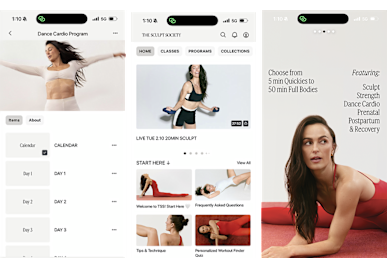 Image by Carleigh Ferrante / mbg creative
- Subscription cost:
- $25 monthly or $180 annually
- Free trial period:
- 7-day free trial
- Workouts offered:
- Prenatal and postpartum workouts, sculpt, low-impact strength, mobility
- Class length:
- 10 to 45 minutes
Pros & Cons
Pros & Cons
Pros
Pregnancy- and postpartum-specific workouts
Low-impact, joint-friendly programming
Encouraging, realistic instruction
Cons
Limited intensity for advanced strength training
Not designed for heavy lifting
While The Sculpt Society isn’t exclusively a prenatal platform, its pregnancy- and postpartum-specific programming is thoughtfully designed and easy to follow. The platform is known for its approachable, feel-good workouts, and its prenatal and postpartum offerings are no exception.
The Sculpt Society’s prenatal and postpartum programming focuses on low-impact, joint-friendly movement that feels supportive during pregnancy and recovery. Classes emphasize strength, mobility, and connection rather than intensity, making them easy to return to even on lower-energy days. The tone is realistic and encouraging, which can make a big difference during this stage of life.
As a whole, The Sculpt Society offers sculpt, dance cardio, and strength classes, as well as full-body classes (which blend all of the above).
The instructors (including the app's founder, Megan Roup) use inclusive language in every class, adhering to all fitness levels. Roup pulls from her professional dance background, adding new choreography to every class, and instructs in an engaging way that makes even non-dancers (it’s me, hi) come back for more.
Our verdict:
The Sculpt Society is a great option for prenatal and postpartum movement that feels safe, supportive, and manageable.
- Subscription cost:
- Free version available; optional paid subscription
- Free trial period:
- Free version; trial available for paid features
- Workouts offered:
- Run, walk, cycling, hiking, and multi-sport activity tracking
- Compatible devices:
- iPhone, Android, Apple Watch, Garmin, Fitbit, and other GPS devices
Pros & Cons
Pros & Cons
Pros
Detailed tracking and performance insights
Strong motivation through community and challenges
Cons
Requires using two apps instead of one
Less strength or cross-training guidance unless added separately


- Subscription cost:
- Monthly and annual options available
- Free trial period:
- Free trial available
- Workouts offered:
- Personalized running plans for 5K, 10K, half marathon, marathon, and general fitness
- Class length:
- N/A
Pros & Cons
Pros & Cons
Pros
Clear, goal-based run training
Strong motivation through community and challenges
Cons
Requires using two apps instead of one
Less strength or cross-training guidance unless added separately
As a marathon runner myself, I know consistency matters more than anything else when training for a race. That’s where Strava and Runna work especially well together.
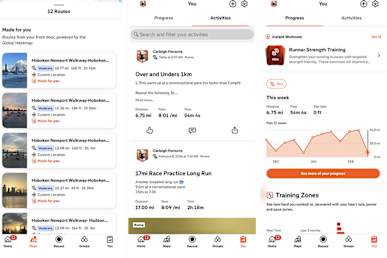
On Strava, you can map routes, log runs, analyze pace, distance, elevation, and heart rate, and see how your training stacks up over time. The social and competitive elements (segments, challenges, clubs) can be surprisingly motivating, especially during longer training blocks.
Runna (acquired by Strava in 2025) is focused entirely on structured run training. After you input your goals, experience level, and available training days, the app builds a personalized plan (whether you’re training for a 5K, half marathon, or marathon). Workouts are clearly outlined, and adapt over time as your fitness improves. You can also add strength training, yoga, pilates, and stretch & stability workouts to your plan.
Used together, Strava and Runna offer both accountability and direction. One helps you follow a smart plan, and the other helps you stay on track and connected with the running community. I used both when training for my last marathon, and I was particularly impressed with how personalized Runna’s training plans are.
Our verdict:
For runners, this pairing covers both structure and motivation. Runna provides the roadmap, and Strava helps you stay invested in the journey.
How to choose the right online workout program
In case you haven’t noticed yet, I’m a bit obsessed with online workout programs. But can you blame me? The ability to access my favorite classes at home has seriously changed my life. It helps me stay consistent and it really fuels my desire to cycle through different types of workouts (which, by the way, might just be the key to living longer).
Needless to say, I’ve tested dozens of platforms—and I’ve learned a thing or two about how to choose the right online workout program. For me, it comes down to a few factors. When picking the best online workout program for you, I recommend asking yourself the below questions:
- Do I want structure or flexibility?
- Am I motivated by accountability or variety?
- How much time do I realistically have per workout?
- What kind of movement do I actually enjoy?
- What equipment do I have access to?
- What’s my budget and how many platforms do I want to sign up for?
At the end of the day, the best online workout program for you is the one you’ll be consistent with. Answering those questions will help you figure out which to try first.
The takeaway
Online workout programs make it easier than ever to find movement that fits your life, schedule, and preferences. Whether you’re looking for structured strength training, low-impact sculpting, or an uplifting group fitness vibe, there’s likely a platform on this list for you.
The key is choosing something that feels sustainable (and yes, maybe even a little fun!) so it becomes part of your routine, rather than another item on your to-do list.